ABOUT
Sally Lundburg is a visual artist based on Hawaiʻi Island whose work explores relationships between people, place, and the natural environment. Working across painting, drawing, photography, and installation, her practice considers movement, memory, identity, and the shifting ways we understand and inhabit landscapes.
Her work is informed by close observation of the environment and an interest in the visible and invisible systems that shape our experience of place. Through layering, accumulation, and juxtaposition, she explores the intersections of natural processes, human histories, and personal experience.
Alongside her individual practice, Lundburg collaborates with artist Keith Tallett on projects that investigate place, connection, and the relationships between people and their surroundings.
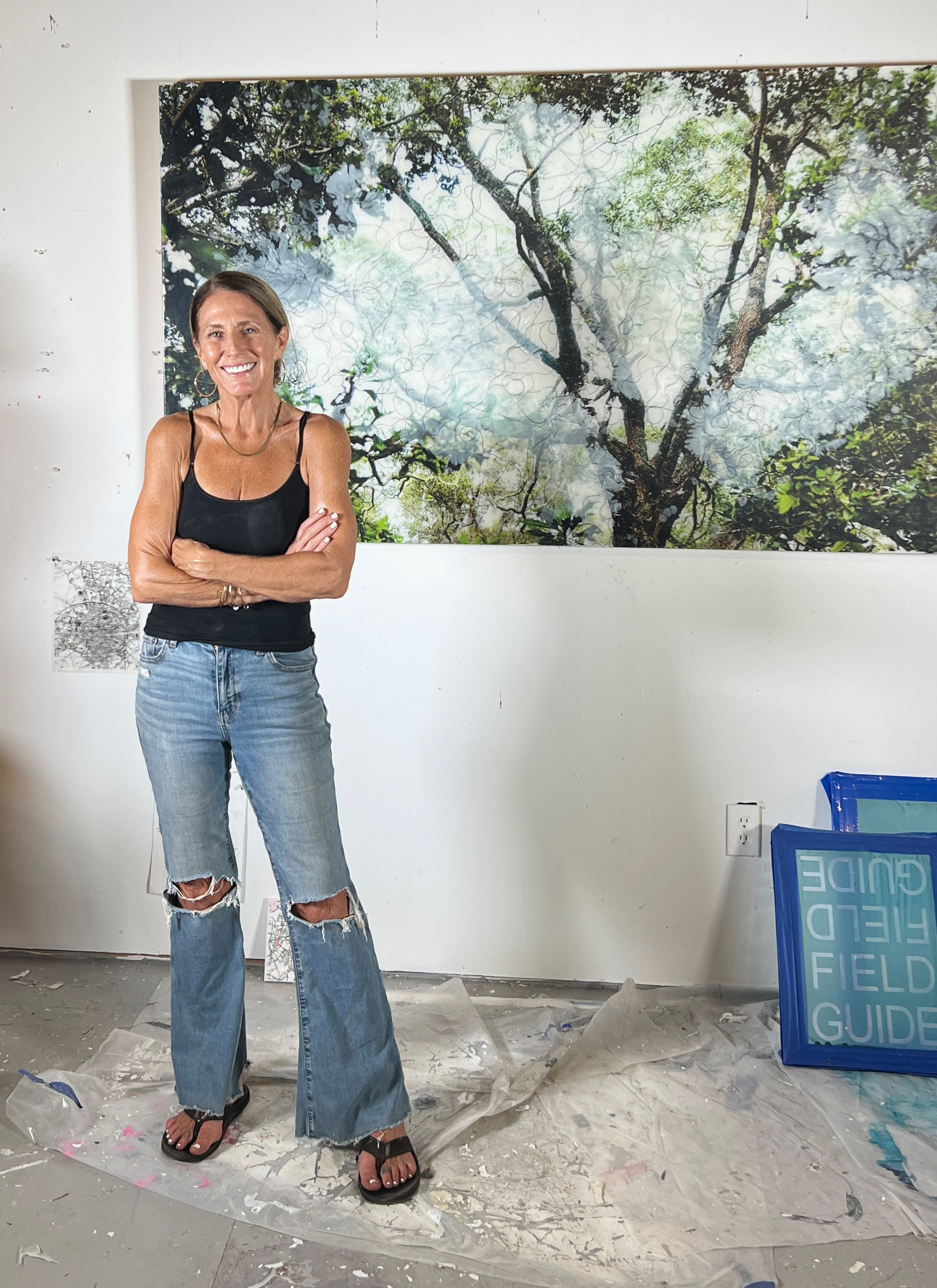
My earliest career interests were journalism, poetry, and anthropology, and I recognize aspects of each in my work today. I've long been drawn to observing, gathering, and interpreting the ways people inhabit and understand their environments.
My practice has moved between painting, drawing, photography, collage, and installation, often incorporating found imagery, archival materials, maps, and text. I also draw from fields such as ecology, forestry, and navigation, where systems of knowledge offer different ways of reading the natural world and our place within it.
Living and working in Hawaiʻi, I am attentive to the ways landscape carries histories of movement, displacement, adaptation, and change. I am interested in the intersections of human and natural systems, and in the spaces where boundaries become uncertain.
In my current work, observation has become increasingly central. Small paintings record fragments of color, atmosphere, and movement, while drawings accumulate lines drawn from overlapping systems of mapping and spatial organization. These works are less concerned with describing a particular place than with exploring the experience of looking, locating, and making sense of what is around us.
Across these different approaches, I return to questions of connection and separation, vulnerability and resilience, and the complicated interdependence of people and place.
Contact →